
Managing Member Data in Generative AI Tools
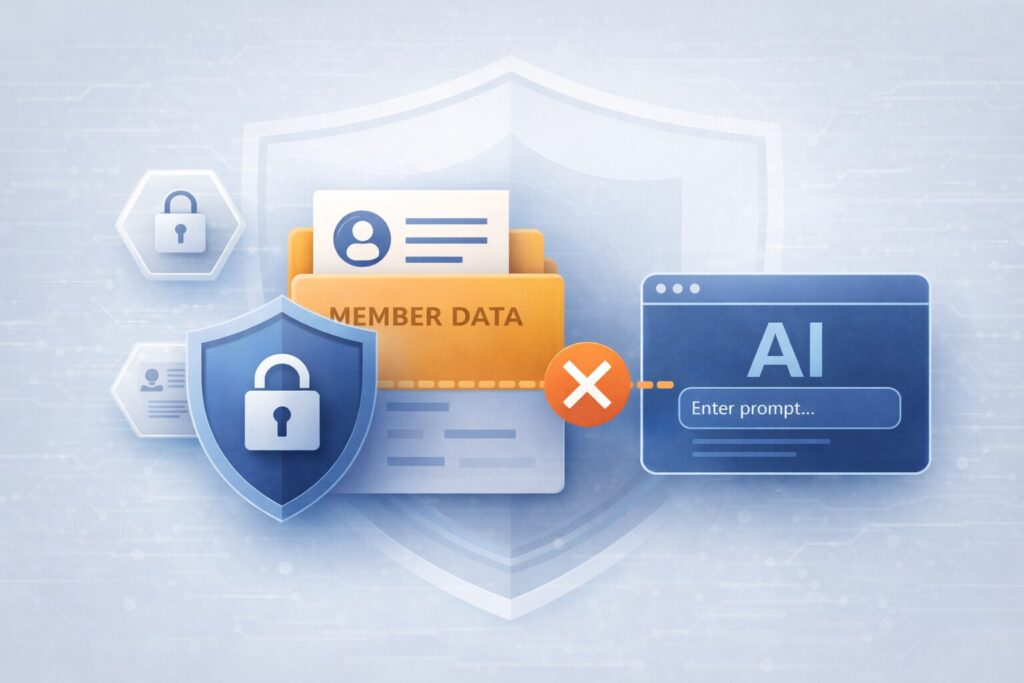
Generative AI tools are increasingly being used inside credit unions for drafting, summarizing, research, and internal communication.
These tools can provide real productivity benefits.
But they also introduce a fundamental governance question:
What member data, if any, may be entered into generative AI systems?
For most financial institutions, the safest and most defensible starting point is simple:
Member data should not be entered into generative AI tools unless a formal review has been conducted and explicit approval has been granted.
Clear guidance on this issue should be a core component of any AI Acceptable Use Policy.
Part of the AI Acceptable Use Policy Framework
This article explores one component of an AI Acceptable Use Policy for credit unions.
For an overview of the full framework, see: AI Acceptable Use Policy Framework for Credit Unions
Why Member Data Requires Special Treatment
Credit unions operate within a regulatory environment built on member trust and data protection.
Member information is not simply internal data. It is:
- regulated
- confidential
- often personally identifiable
- tied directly to financial accounts
Uploading that information into generative AI tools—even unintentionally—can create governance challenges related to:
- privacy obligations
- data handling practices
- third-party risk
- audit defensibility
In many cases, employees do not intend to expose sensitive information. They are simply trying to complete a task more efficiently.
Clear policy guidance prevents accidental exposure.
What Counts as Member Data?
Policies should clearly define the types of information considered member data.
Examples may include:
- member names
- account numbers
- Social Security numbers
- loan application details
- account balances
- transaction histories
- contact information
- authentication information
- internal case notes tied to specific members
Even partial data elements can become sensitive when combined with other information.
For this reason, many institutions treat any information tied to a specific member as restricted.
Default Policy Approach: Prohibit Member Data
For many credit unions, the most practical and defensible policy approach is to prohibit the entry of member data into generative AI tools.
This simplifies governance and reduces ambiguity for employees.
When Exceptions May Be Considered
In some situations, institutions may decide to allow limited use of member-related data in specific AI tools.
These situations should require formal review and approval from compliance, legal, and information security teams before the use case is permitted.
This typically requires additional safeguards, such as:
- internally hosted or privately deployed AI systems operating within the credit union’s controlled infrastructure or private cloud environment
- enterprise AI platforms with contractual privacy protections
- documented vendor review
- internal legal and compliance approval
- clearly defined use cases
- audit logging and oversight
Examples of approved use cases might include:
- anonymized case summaries
- internal research using redacted information
- operational analysis that does not identify specific members
Even in these cases, the burden of governance remains high.
Approval should be intentional and documented.
When generative AI tools are provided by third-party vendors, their use should also align with the credit union’s vendor management and third-party risk oversight processes.
Documenting Approved Use Cases
If a credit union permits limited use of member-related data in generative AI tools, those uses should be documented and approved as specific use cases.
Documentation may include:
- the approved AI platform
- the type of member information involved
- the purpose of the use
- required redaction procedures
- oversight responsibilities
- the department or governance group responsible for approving the use case
Maintaining a documented list of approved AI use cases helps ensure that AI usage remains intentional and defensible.
This documentation can also assist during regulatory examinations by demonstrating that AI usage has been intentionally governed.
Redaction and Anonymization
Some institutions allow the use of redacted or anonymized information when interacting with AI tools.
For example:
Instead of entering:
“Member John Smith’s loan application shows inconsistent income documentation.”
An employee might write:
“A loan application includes inconsistent income documentation across multiple supporting documents. What follow-up questions should be asked?”
This approach allows staff to obtain guidance without exposing identifiable member data.
However, policies should still caution employees that redaction must be thorough.
Incomplete anonymization can still expose sensitive information.
Escalating Uncertain Situations
Employees will occasionally encounter situations where it is unclear whether information qualifies as member data.
Your policy should define a simple escalation path for these cases.
For example:
- employees should pause the AI interaction
- questions should be directed to a supervisor, compliance officer, or information security team
- the use case should be reviewed before proceeding
Providing a clear escalation path prevents employees from making risk decisions on their own.
Clear escalation procedures also reinforce that AI usage is a governance issue, not simply a productivity decision.
Training Staff to Recognize Risk
Many AI-related data exposures occur not because of malicious intent but because employees do not fully understand how generative AI systems handle information.
Training programs should emphasize:
- what qualifies as member data
- why that data is sensitive
- when AI tools may be used safely
- how to redact information properly
- when questions should be escalated
When employees understand the reasoning behind the policy, compliance improves significantly.
Aligning with Existing Data Governance Policies
Your AI Acceptable Use Policy should not exist in isolation.
Guidance around member data should align with existing frameworks, such as:
- information security policies
- data classification policies
- privacy policies
- vendor management procedures
Consistency across governance documents strengthens defensibility during regulatory reviews.
AI usage policies should align with the credit union’s existing data classification standards, ensuring that member information receives the same protections regardless of the technology being used.
Governance Over Convenience
Generative AI tools make it easy to paste information into a prompt window.
That convenience is precisely why clear guardrails are necessary.
Credit unions do not need to prohibit AI use entirely.
But they do need to ensure that member data is handled with the same care in AI systems as it is in every other technology platform.
Credit unions should treat generative AI tools as third-party technology platforms when evaluating data handling risks.
Clear policy language, staff training, and intentional governance make that possible.
A Simple Rule for Most Institutions
When employees are unsure whether information qualifies as member data, the safest assumption is simple:
If the information relates to a specific member, it should not be entered into generative AI tools unless the use case has been formally reviewed and approved.
This principle protects both the institution and the member relationship while ensuring that AI adoption remains aligned with regulatory expectations.
