
Consumer vs. Enterprise AI: What Credit Unions Need to Understand Before Choosing a Tool
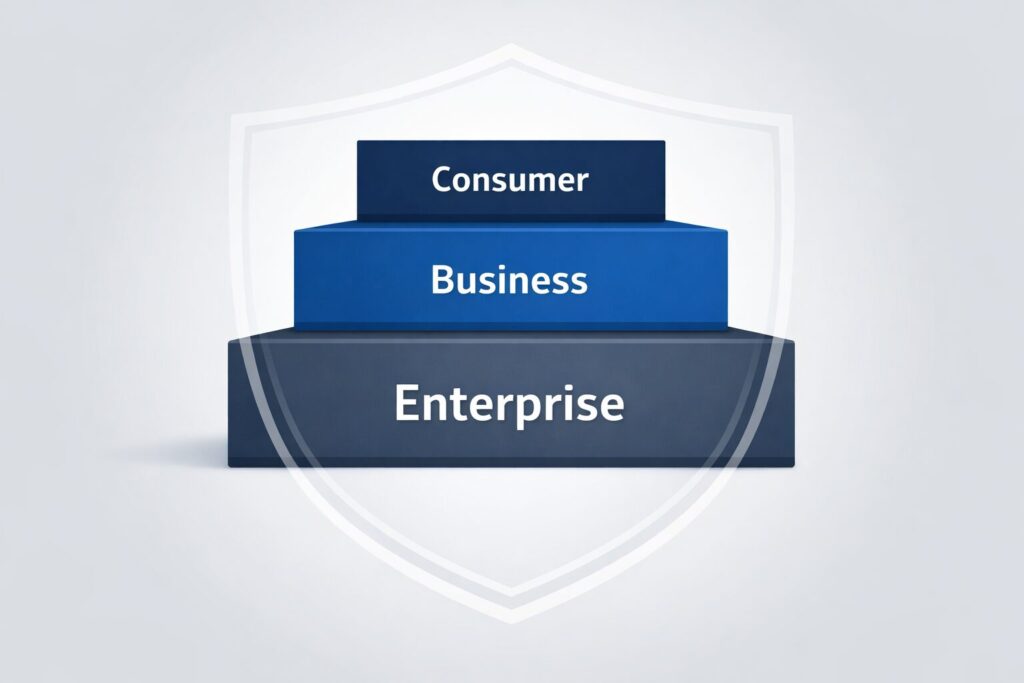
Artificial intelligence platforms now offer multiple tiers. For credit unions, the distinction between them is not about model quality.
It is about governance posture.
For practical purposes, AI tools fall into three meaningful institutional categories.
1. Consumer / Free AI Tools
These include the free versions of widely available platforms such as:
- OpenAI (ChatGPT Free)
- Anthropic (Claude Free)
- Google (Gemini Free)
- xAI (Grok Free tier)
Characteristics:
- Designed for individual use
- No institutional contract
- No centralized administrative oversight
- Not integrated into vendor management programs
- Individual employees may sign up independently
These tools are powerful.
They are not structured for regulated institutional governance.
For credit unions, consumer tiers should generally be limited to experimentation using public or non-sensitive information only.
2. Business / Team AI Plans
This middle category is where many institutions get confused.
Examples include:
- ChatGPT Business
- Claude Teams
- Gemini Enterprise Standard
- Gemini Enterprise Plus
- Grok Business
These typically offer:
- Administrative dashboards
- Centralized billing
- Improved privacy commitments
- More defined data handling terms
- Workspace or domain-level controls
For many credit unions, this tier may be appropriate for:
- Executive use
- Policy drafting
- Internal content development
- Summarization of internal (non-member) materials
However, governance questions still apply:
- Is the service under formal vendor review?
- Has legal reviewed the data protection terms?
- Are member-related data uploads restricted?
- Is usage logged and auditable?
Business tiers improve control—but they do not automatically eliminate risk.
3. Enterprise AI Platforms
Enterprise tiers are designed for institutional integration.
Examples include:
- ChatGPT Enterprise
- Claude for Enterprise
- Microsoft Copilot for Microsoft 365
- Gemini for Google Workspace Enterprise
Enterprise platforms typically provide:
- Contractual data isolation commitments
- Administrative enforcement controls
- SSO integration
- Audit logging
- SOC documentation
- Vendor risk documentation
- Integration with existing enterprise security controls
For credit unions operating in a regulatory environment, this tier provides the most defensible governance posture.
It does not remove responsibility.
It makes oversight manageable.
Why This Distinction Matters
Many institutions assume:
“Paid equals safe.”
That is not always true.
The more accurate statement is:
The appropriate AI tier depends on the sensitivity of the data and the institution’s governance maturity.
For example:
- Public marketing copy: Business tier may be sufficient.
- Internal operational procedures: Business or Enterprise.
- Vendor contracts with security architecture details: Enterprise.
- Member data: Extreme caution, formal review required.
AI tool selection is not about model intelligence.
It is about risk classification.
A Governance-First Model for Credit Unions
A practical starting point for many institutions:
Consumer AI
- Personal experimentation only
- No institutional data
Business / Team AI
- Limited internal institutional use
- Clear internal policy
- No member data unless approved
Enterprise AI
- Approved for operational and strategic institutional use
- Integrated into vendor management
- Documented oversight and review
This structure gives leadership something clear to reference.
It prevents shadow AI adoption.
It creates defensibility.
