
Defining Prohibited Data Categories in AI Policies for Credit Unions
Generative AI tools are powerful.
They can summarize documents, draft communications, assist with research, and improve productivity across many areas of a credit union.
But the primary risk associated with generative AI is not the technology itself.
It is data exposure.
Most AI incidents occur when sensitive information is uploaded into systems that were never intended to process or store that type of data. In many cases, the employee involved is simply trying to work more efficiently.
A well-designed AI Acceptable Use Policy should address this directly by defining what information may never be entered into generative AI systems.
Clear data boundaries protect the institution while still allowing employees to benefit from AI tools.
Part of the AI Acceptable Use Policy Framework
This article explores one component of an AI Acceptable Use Policy for credit unions. For an overview of the full framework, see: AI Acceptable Use Policy Framework for Credit Unions.
Within that framework, defining prohibited data categories is one of the most important governance controls.
Without it, even approved AI platforms can become a source of unintended risk.
What Your Policy Should Define
Your AI policy should clearly describe which types of information may not be uploaded into generative AI platforms unless formally reviewed and approved.
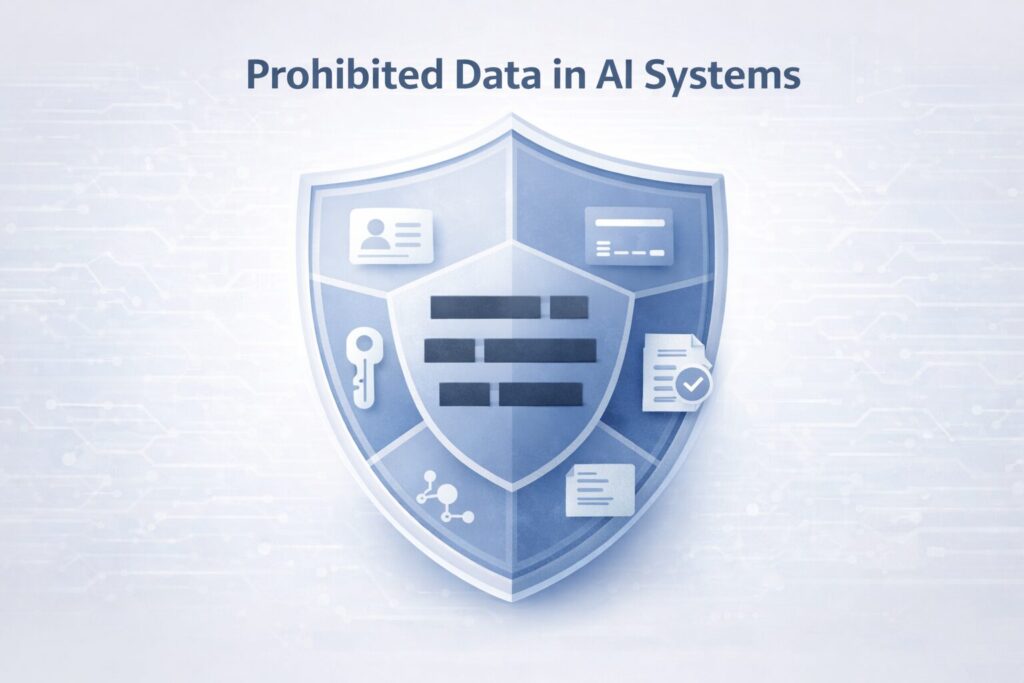
Typical prohibited categories include:
- Member personally identifiable information (PII)
- Account numbers or financial identifiers
- Social Security numbers
- Loan application data
- Authentication credentials
- Security architecture details
- Confidential vendor contracts or security documentation
These restrictions should align with your credit union’s existing:
- Information security policies
- Data classification framework
- Vendor risk management practices
The AI policy should not introduce entirely new data rules. Instead, it should extend existing governance practices into the use of generative AI tools.
Why Data Restrictions Matter
When employees interact with generative AI platforms, they are typically submitting prompts that may contain institutional information.
Depending on the platform and service tier, prompts may be:
- processed by external infrastructure
- retained for system improvement
- stored temporarily or logged
- subject to vendor data policies
Even when an AI vendor offers strong privacy commitments, credit unions must assume that any information uploaded into external systems carries some level of exposure risk.
Defining prohibited data categories provides a simple and defensible rule:
Certain information should never be entered into generative AI systems.
This clarity prevents employees from having to make judgment calls about sensitive information in the moment.
Core Categories of Prohibited Data
While each credit union may refine its own definitions, several categories are commonly restricted.
Member Personally Identifiable Information
Member data is the most obvious category.
This typically includes:
- Names paired with identifying details
- Addresses
- Dates of birth
- Member numbers
- Social Security numbers
- Driver’s license numbers
Even if a platform offers enterprise privacy protections, many institutions choose to prohibit entering member PII into generative AI systems without explicit approval.
This is not simply a technology decision.
It is a trust decision.
Members expect their financial institution to treat personal information with the highest level of care.
Account and Financial Identifiers
Financial account information should also be restricted.
Examples include:
- Account numbers
- Routing numbers
- Credit card numbers
- Debit card numbers
- Transaction histories tied to identifiable members
Even partial account identifiers can present risk when combined with other information.
For this reason, many policies prohibit entering any member-specific financial account information into AI platforms.
Loan Application and Underwriting Information
Loan application data can contain highly sensitive information.
This may include:
- income documentation
- credit report data
- employment information
- debt obligations
- collateral details
Uploading this information into generative AI systems introduces potential regulatory concerns, particularly when the data relates to lending decisions.
For most institutions, loan application information should be treated as restricted data unless an AI use case has undergone formal review.
Authentication Credentials
Authentication information should always be prohibited.
Examples include:
- Passwords
- Multifactor authentication codes
- Security questions
- API keys
- System credentials
Even in test scenarios, these details should never be entered into AI tools.
This category aligns closely with existing cybersecurity policies and should be straightforward to enforce.
Security Architecture and System Design
Information about your credit union’s internal technology environment can also create risk.
Examples may include:
- network architecture diagrams
- vulnerability reports
- cybersecurity monitoring configurations
- penetration testing results
- internal incident response procedures
Sharing this type of information with external AI systems may unintentionally expose details that could assist a threat actor.
For that reason, many institutions restrict uploading security architecture or security operations information into generative AI platforms.
Confidential Vendor and Contract Information
Vendor agreements and technology contracts often contain sensitive operational details.
These may include:
- pricing structures
- system architecture descriptions
- security commitments
- internal integration details
- proprietary vendor documentation
While AI tools can be helpful for reviewing contracts or summarizing legal language, institutions should be cautious about uploading full vendor agreements into AI systems without proper review.
Some credit unions allow redacted or sanitized excerpts to be analyzed, but full contractual documents are often restricted.
Additional Institutional Data to Consider
Beyond the most obvious categories, credit unions may choose to restrict additional types of internal information.
These may include:
Internal Audit Findings
Audit reports may identify operational weaknesses, security issues, or regulatory concerns. Uploading those findings into external systems could create unnecessary exposure.
Incident Response or Cybersecurity Investigations
Documentation related to security incidents, forensic investigations, or internal remediation efforts should typically remain within controlled internal systems.
Legal or Compliance Investigations
Sensitive compliance reviews or legal matters should not be shared with AI tools unless the use case has been reviewed and approved by the appropriate governance teams.
Human Resources Disciplinary Information
Personnel records and disciplinary documentation involve confidential employee information and should remain within secure HR systems.
These additional categories are not unique to AI governance.
They are already treated as sensitive information under most institutional data protection policies.
Sample Policy Language
Many institutions include simple language in their AI policy that references these categories directly.
– Member personally identifiable information
– Account numbers or financial identifiers
– Loan application or underwriting data
– Authentication credentials or system passwords
– Internal security architecture or cybersecurity documentation
– Confidential vendor contracts or proprietary operational materials
Employees must follow the credit union’s existing data classification and information security policies when interacting with AI tools.
Aligning AI Restrictions with Data Classification
The most effective AI policies do not invent entirely new categories of restricted information.
Instead, they extend the institution’s existing data classification model.
For example:
| Data Classification | AI Policy Approach |
|---|---|
| Public information | May generally be used with AI tools |
| Internal operational information | May be used with caution |
| Confidential institutional data | Often restricted |
| Member-sensitive data | Typically prohibited |
This alignment ensures that AI governance reinforces existing security frameworks rather than creating separate or conflicting rules.
Handling Edge Cases
AI tools can sometimes provide legitimate value when working with sensitive materials.
Examples might include:
- summarizing anonymized operational data
- reviewing policy drafts that contain no member information
- analyzing redacted contract language
Because of this, some institutions include language that allows approved exceptions.
For example, a compliance or legal team may authorize a specific AI use case after reviewing the platform’s privacy controls and data protections.
The key is that these exceptions should be intentional and documented, rather than decided ad hoc by individual employees.
Clear Boundaries Enable Responsible AI Use
Credit unions do not need to prohibit generative AI.
In fact, many institutions are already benefiting from these tools for internal productivity, research, and communication.
But responsible adoption requires clarity.
Defining prohibited data categories allows employees to experiment with AI tools confidently, knowing where the boundaries exist.
Without those boundaries, employees must guess what information is safe to share.
Governance removes that guesswork.
When policies clearly define restricted information, generative AI can be used as a productivity tool—without creating unnecessary institutional risk.
