
Approved AI Platforms for Credit Unions
Generative AI tools are easy to access.
That accessibility creates both opportunity and risk for financial institutions.
Without clear guidance, staff may use a wide range of consumer AI tools—often with good intentions but without understanding how those platforms handle data, retain prompts, or train their models.
An AI Acceptable Use Policy should begin with a simple but foundational decision:
Which AI platforms are approved for institutional use?
Defining approved platforms creates consistency, aligns AI usage with vendor management practices, and helps ensure that generative AI tools are used responsibly within your credit union.
Part of the AI Acceptable Use Policy Framework
This article explores one component of an AI Acceptable Use Policy for credit unions. For an overview of the full framework, see: AI Acceptable Use Policy Framework for Credit Unions
What Your Policy Should Define
When documenting approved AI platforms, your policy should clearly address the following:
- Which generative AI platforms are approved for institutional use
- Whether consumer or free versions are permitted
- Whether business or enterprise accounts are required
- Who has authority to approve new AI platforms
- How AI vendors are reviewed through the vendor management process
- Where employees can find the official list of approved platforms
These elements establish the governance foundation for responsible AI usage inside the credit union.
Why Platform Approval Matters
When employees experiment with generative AI tools independently, several governance issues can emerge:
- Staff may upload sensitive internal information into consumer AI systems
- Different departments may adopt different tools without oversight
- Data retention policies may be unclear or inconsistent
- Vendor risk management processes may be bypassed
These risks are rarely caused by intentional misuse. Most often, they occur because employees are simply trying to improve productivity.
A clear list of approved platforms allows credit unions to support innovation while maintaining appropriate controls.
Defining Approved AI Platforms
Your policy should explicitly identify which generative AI platforms are permitted for institutional use.
Examples may include:
- Enterprise AI platforms approved by the institution
- Business-tier subscriptions that include enterprise privacy protections
- Specific productivity tools with embedded AI capabilities
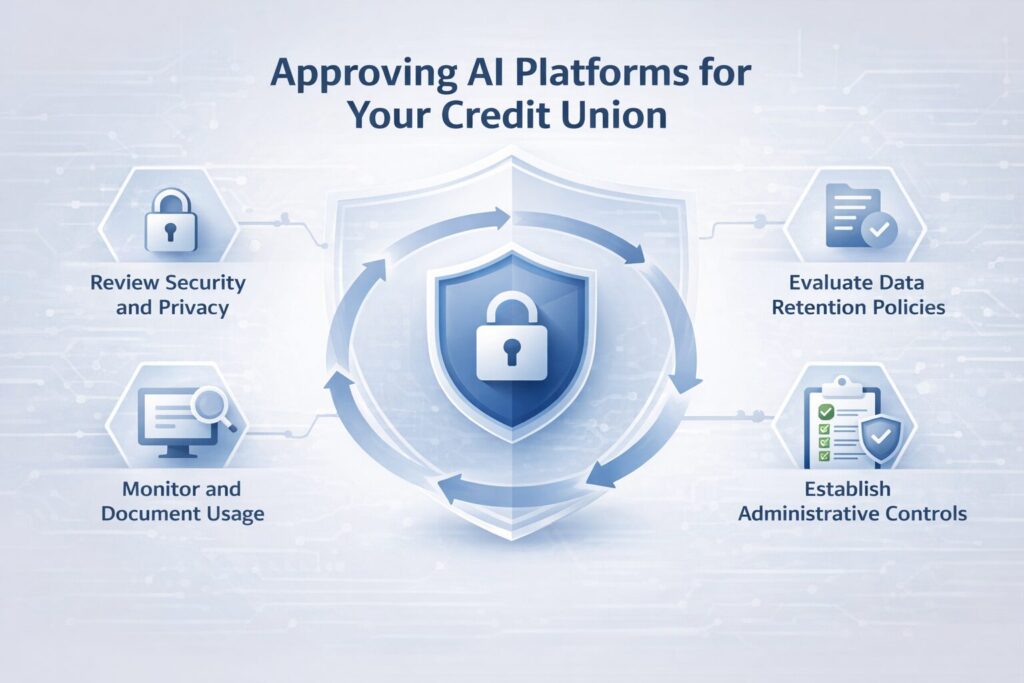
In most cases, approved platforms should meet several criteria:
- Vendor security and privacy practices have been reviewed
- Data retention and training policies are documented
- Administrative controls are available
- Usage can be monitored or audited
- Contractual protections are in place
The goal is not to eliminate experimentation. The goal is to ensure that experimentation occurs within a governed environment.
Consumer vs. Business vs. Enterprise AI Accounts
Many generative AI tools offer multiple service tiers, each with different privacy protections and administrative controls.
Your policy should address which tiers are permitted.
A simple framework may include:
Consumer and Free Versions
These versions are typically designed for individual users. Prompts may be retained for model improvement, and administrative controls are usually unavailable.
Most institutions should prohibit the use of consumer AI accounts for work-related activities.
Business Accounts
Business subscriptions often include stronger privacy protections and administrative capabilities. In many cases, prompts are not used for model training, and organizational controls can be implemented.
These tiers may be appropriate for departments experimenting with generative AI tools under supervision.
Enterprise Platforms
Enterprise deployments typically offer:
- centralized administration
- identity management integration
- usage logging
- enhanced data protections
For larger credit unions, enterprise deployments may be the preferred model for long-term AI adoption.
Aligning AI Platforms with Vendor Management
Approved AI platforms should be treated similarly to other technology vendors.
Your review process may include:
- Information security review
- Data privacy review
- Vendor risk assessment
- Contractual terms evaluation
- Data handling and retention analysis
Some institutions may also evaluate whether the platform provides:
- SOC 2 reports
- data processing agreements
- regional data residency options
AI tools should not bypass existing vendor governance frameworks simply because they appear to be productivity tools.
Defining an Approval Process for New Platforms
AI tools evolve quickly. New platforms appear regularly, and existing platforms release new capabilities.
Your policy should define how additional AI platforms can be evaluated and approved.
This process may include:
- Submission of a platform for review
- Evaluation by IT and information security
- Compliance and legal review where appropriate
- Formal approval by a designated governance group
This approach allows the institution to remain adaptable while maintaining oversight.
Communicating Approved Platforms to Staff
Once platforms are approved, the list should be easy for employees to find and understand.
Best practices may include:
- Maintaining an internal AI usage guide
- Listing approved platforms within the AI Acceptable Use Policy
- Publishing examples of acceptable use cases
- Providing training that demonstrates proper usage
When employees understand which tools are approved, they are far more likely to adopt them responsibly.
The sections above establish the foundation for defining approved AI platforms within an AI Acceptable Use Policy.
Innovation with Guardrails
Credit unions do not need to prohibit generative AI.
In many cases, these tools can improve productivity, communication, and internal knowledge work.
However, responsible adoption begins with clear boundaries.
By defining approved AI platforms, credit unions can encourage experimentation while ensuring that generative AI tools are used within a controlled and defensible governance framework.
Establish the platform list first.
Then build your policy outward from there.
In many credit unions, this becomes the first step toward establishing a broader AI governance framework.
